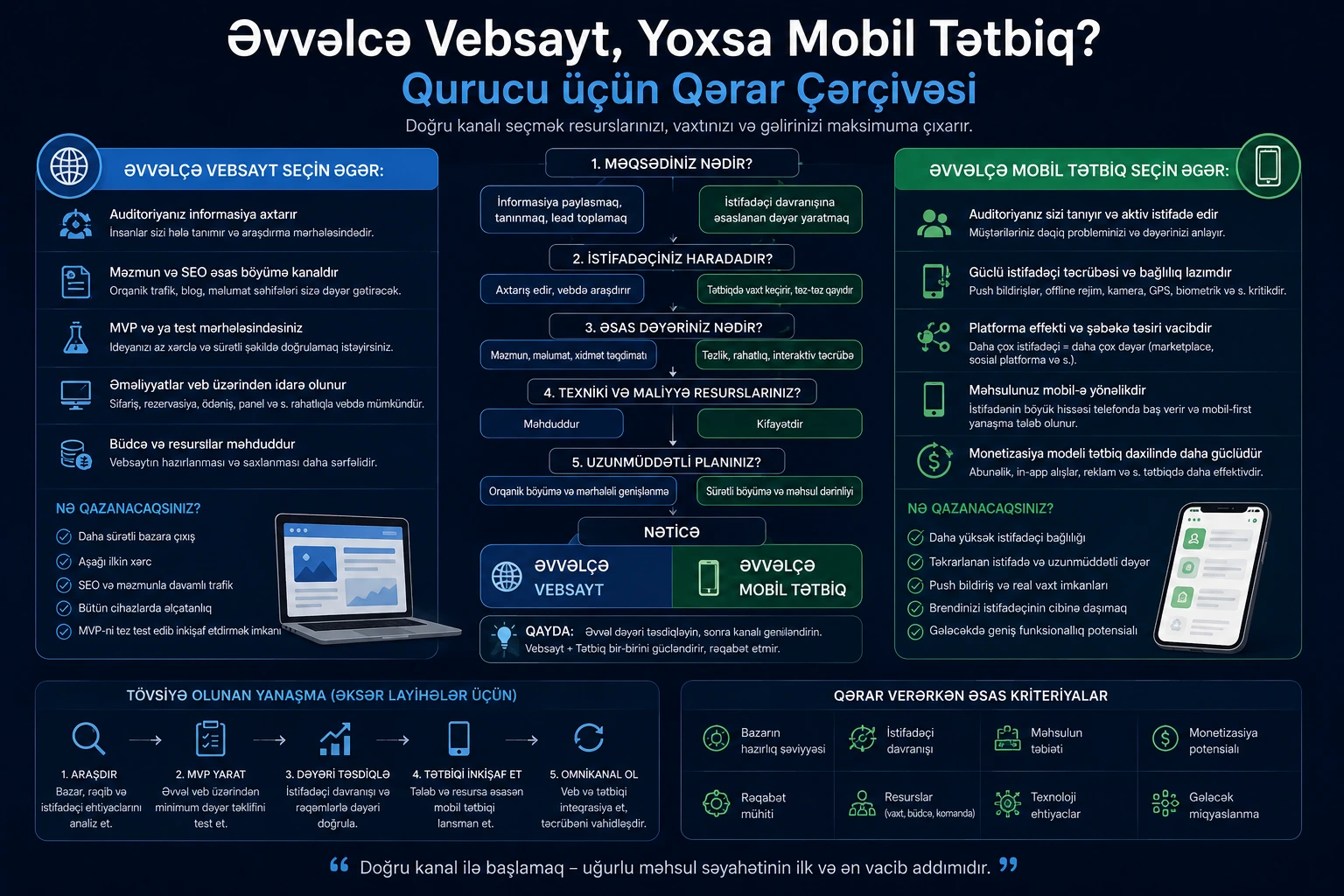
"Should we build a website or a mobile app?" is one of the first big questions a founder faces, and it is often answered with personal taste rather than evidence. Most early-stage businesses cannot afford to build and maintain both well at the same time, so the decision is really about sequencing: which one earns its keep first. This framework replaces gut feeling with a structured way to decide.
Start With the Customer's Habit, Not Your Preference
The right first product is not the one that feels more modern — it is the one that matches how your customers already behave. A local service business whose customers search on Google before calling needs a fast, SEO-friendly website long before it needs an app. A business built around daily repeat engagement, like a loyalty program or booking tool people open several times a week, gets far more value from a mobile app.
Build for the behavior your customers already have, not the behavior you wish they had.
The Website-First Case
Websites are cheaper to build, faster to iterate on, and instantly indexable by search engines. For most B2B companies and service providers, a well-built website with clear conversion paths — contact forms, pricing, case studies — will outperform an app in generating actual leads, because nobody is willing to download an app just to get a quote. A website is also your discoverability layer: it is where search traffic lands, where ads point, and where a first-time visitor decides whether to trust you.
Choose website-first when
- Customers discover you through search engines or ads.
- The interaction is occasional — a purchase, a booking, an inquiry — rather than daily.
- Your priority is credibility, reach, and lead generation.
- Budget is tight and you need results quickly.
The App-First Case
Apps win when the value depends on frequency, notifications, or device features like the camera, GPS, or offline access. Marketplaces, delivery platforms, and fitness or habit-tracking products typically need an app early, because the retention mechanics — push notifications, home-screen presence — are core to the business model, not an add-on.
Choose app-first when
- Customers engage daily or several times a week.
- The product depends on notifications to drive repeat use.
- You need hardware access — camera, GPS, sensors, offline mode.
- Retention and habit formation are the core of the business.
A Middle Path: Responsive Web First, Native Later
A common and expensive mistake is building a native app before validating demand. Launching a responsive, app-like website — or a progressive web app — first lets a business test its core flow with real users at a fraction of the cost, then justify native development once usage numbers support it. This staged approach de-risks the biggest investment by proving the concept before you commit to the app-store treadmill of reviews, updates, and platform-specific builds.
The Real Cost Nobody Budgets For
The build is only the beginning. A native app carries ongoing costs a website does not: two codebases (iOS and Android) or a cross-platform stack to maintain, app-store review cycles, forced updates when the OS changes, and a much higher bar for the first release because users judge apps harshly. A website updates instantly for everyone. Factor total cost of ownership, not just the initial build, into the decision.
Conclusion
There is no universal winner — only the right first move for your customer's behavior, your budget, and your growth model. For most service businesses and B2B companies, a website earns its keep first. For frequency-driven, notification-dependent products, an app does. When in doubt, validate with responsive web, then invest in native once the numbers justify it.
