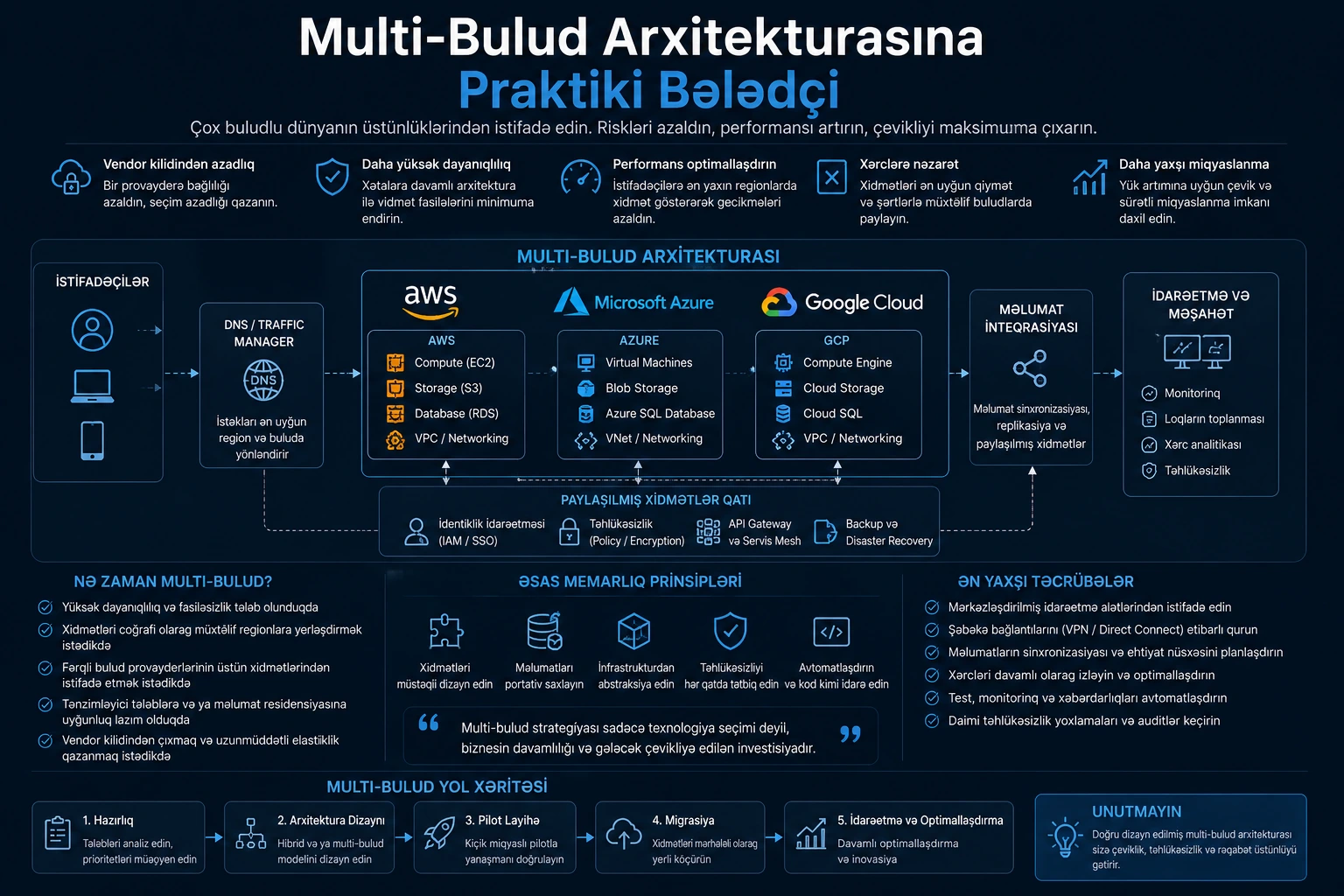
"Multi-cloud" is one of those phrases that sounds unambiguously good — more resilience, no lock-in, better leverage. In practice it is a spectrum of strategies with very different costs and payoffs, and choosing the wrong point on that spectrum can double your operational burden while delivering none of the promised benefits. This guide separates the real value from the marketing.
What Multi-Cloud Actually Means
The term hides at least three distinct strategies that people constantly conflate:
- Redundant multi-cloud — running the same workload across two providers for failover. Maximum resilience, maximum cost and complexity.
- Best-of-breed multi-cloud — using each provider for its strongest service (one cloud's data warehouse, another's ML tooling). Pragmatic and common.
- Accidental multi-cloud — different teams picked different providers over time. The most common reality, and rarely a strategy at all.
Being honest about which one you are actually pursuing is the first step, because each has a completely different cost-benefit profile.
The Genuine Benefits
Resilience against provider-wide failure
Major providers do have region-wide and occasionally provider-wide outages. If your business genuinely cannot tolerate hours of downtime, cross-provider redundancy is a real insurance policy — but you pay for it in duplicated infrastructure and constant testing.
Negotiation leverage
A credible ability to move workloads gives you real pricing leverage at contract renewal. The word credible is doing heavy lifting: leverage only exists if migration is actually feasible.
Access to the best services
No single provider is best at everything. Being able to use a superior managed service from another cloud is often the most practical reason to go multi-cloud.
The Costs Nobody Advertises
Every benefit has a price tag that vendors rarely mention:
- Operational surface area. Two clouds means two IAM models, two networking stacks, two billing systems, and two sets of on-call expertise.
- Data egress fees. Moving data between clouds is expensive and slow. Architectures that shuttle data across providers bleed money.
- Lowest-common-denominator design. To stay portable, teams often avoid the powerful proprietary services that made a cloud worth choosing in the first place.
- Talent cost. Deep expertise in one cloud is hard enough to hire; demanding it in two is harder and more expensive.
Multi-cloud for portability often means giving up the exact managed services that would have made you fastest on a single cloud.
The Abstraction Layer That Makes It Work
When multi-cloud is the right call, the way to stay sane is to standardize on portable primitives. Containers (Docker), orchestration (Kubernetes), and infrastructure as code (Terraform) let you describe workloads and infrastructure in a provider-neutral way. These abstractions are what turn "lock-in" from a trap into a manageable trade-off — but they are themselves a significant system to operate.
A Practical Recommendation
For most companies, the right answer is: go deep on one primary cloud, and be deliberate about the few exceptions. Master one provider's services to move fast, keep your architecture containerized so you retain a credible exit, and only add a second provider for a specific, justified reason — a best-of-breed service or a hard resilience requirement. Multi-cloud should be a targeted decision, not a default posture.
Conclusion
Multi-cloud is a powerful strategy when it solves a real problem — resilience, leverage, or access to a specific capability — and an expensive distraction when adopted for its own sake. Decide which specific benefit you are buying, price the operational cost honestly, and let that trade drive the architecture.
